The Buffett Indicator
Warren Buffett is probably the most famous investor alive. My approach to investing is different from his, so I haven't spent much time studying his methods. But everyone knows him, and lately people have been obsessed with Berkshire Hathaway's record cash pile - $373 billion as of Q1 2026 (Barron's, April 2026).
The narrative: Buffett is sitting on cash because he can't find anything worth buying. Markets are expensive. A crash is coming.
One metric keeps getting cited as evidence: the Buffett Indicator. Fortune ran a piece on April 19 asking "What is the Buffett Indicator and is the stock market about to crash?"
I wanted to understand what this actually measures and whether it's telling us anything useful.
What Is the Buffett Indicator?
The Buffett Indicator is the ratio of total US stock market capitalization to GDP.
Buffett called this "probably the best single measure of where valuations stand at any given moment" in a 2001 Fortune interview.
The logic: stock market value should track economic output. If market cap grows much faster than GDP, stocks are overvalued relative to the underlying economy.
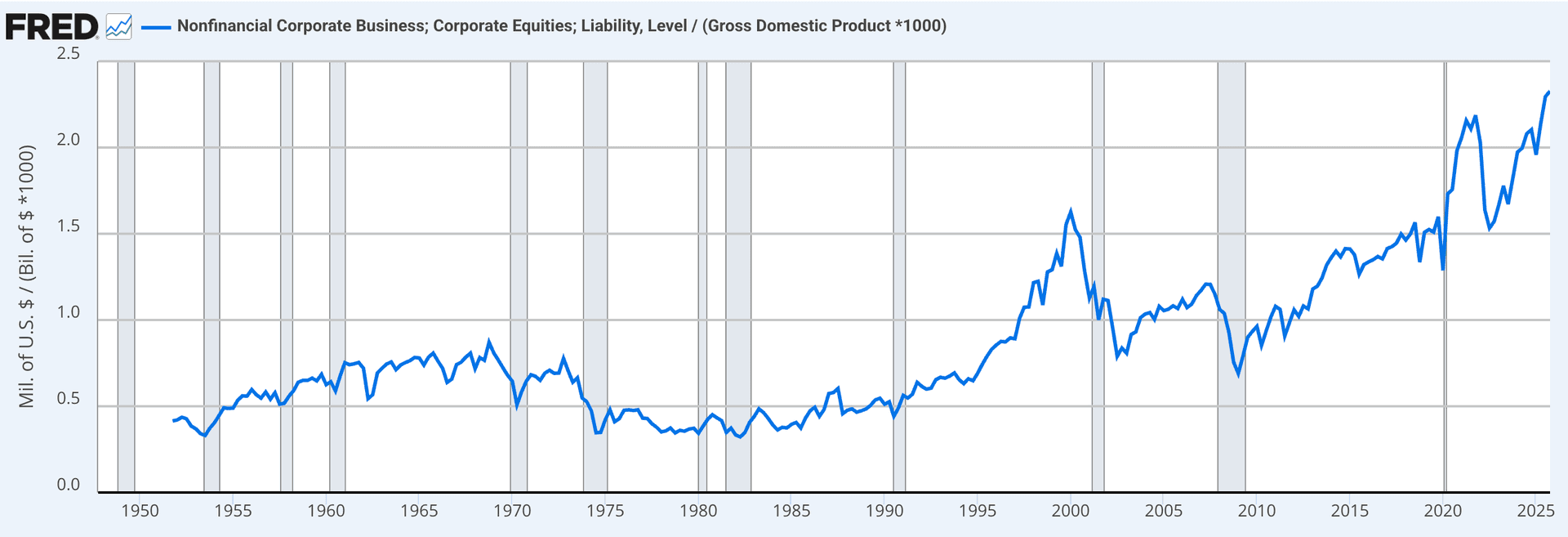
As of April 2026, the Buffett Indicator sits around 230% - meaning the total stock market is worth over twice annual GDP.
By this measure, US equities are more expensive than at any point in history, including the dot-com bubble.
The Buffett Indicator reached dot-com bubble levels around 2018 and kept climbing, but no crash came. Why is that?
Since 2008, the Fed expanded its balance sheet from ~$800 billion to over $9 trillion through quantitative easing and debt monetization. Traditional valuation metrics assume market prices reflect organic economic activity. But when the central bank injects trillions into the financial system, that assumption breaks.
If Fed intervention artificially inflates equity prices, the standard Buffett Indicator is measuring the wrong thing.
Adjusted Buffett Indicator
If Fed balance sheet expansion inflates equity prices artificially, we should adjust for it.
Adjusted Formula: ((Total Market Cap - Fed Balance Sheet) / GDP)
This removes the Fed's direct contribution from the numerator, showing what market cap would be without central bank intervention.
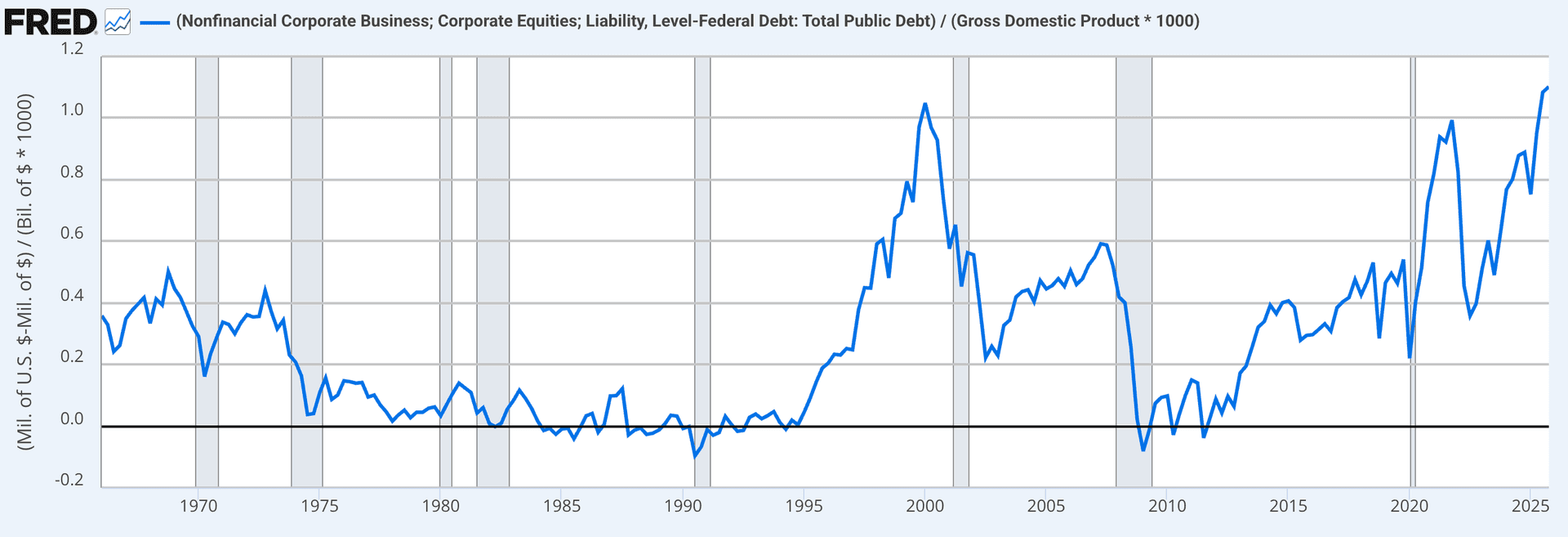
The adjusted metric tells a clearer story:
- Dot-com peak (2000): 1.0
- 2018: Below 0.6 (not a bubble)
- Q4 2021 (everything bubble peak): 1.0
- Today: 1.1—highest level in 60 years
Even accounting for Fed support, US equities are at record valuations.
What This Means Now
Both metrics, original and adjusted, suggest this is not a good time to own US equities.
Add in the current environment:
- Two months into a war that closed the Strait of Hormuz
- Oil at $105 (+57% from pre-war levels)
- SPX at all-time highs
Sitting on cash doesn't seem crazy right now.