Repo Market Mechanics
In my previous post about QE5, I showed that the Fed doesn't restart QE because of economic data - it restarts when financial market plumbing breaks. Specifically, when the repo market seizes up.
But what exactly is the repo market? And why does it have the power to force the Fed's hand? This post explains the key mechanics and metrics I track for Fed liquidity and repo market health.
What Is a Repo Transaction?
A repo (repurchase agreement) is a contract where you sell securities, usually Treasuries, and commit to buying them back the next day at a slightly higher price. That price difference, expressed as an annual percentage rate, is called the repo rate.
Why not simply sell today and buy back tomorrow? Transaction costs and legal treatment. Each outright sale creates settlement complexity and legal risk. Repos solve this by being structured as a single transaction - legally recognized as one operation, not two separate trades.
For tax purposes, repos are typically treated as secured loans rather than sales, meaning the repo seller remains the tax owner of the securities. This avoids triggering capital gains events while still providing the cash needed.
This legal structure makes repo the most efficient way to turn Treasuries into cash equivalents. If you hold Treasuries but need cash for a day, you can repo them out. The next day, you get your Treasuries back and the lender gets their cash back plus interest.
This efficiency makes repo rates the de facto measure of the cost of money in the financial system.
The Cost of Money: How Fed Rates Work
The fundamental rate is the federal funds rate - the rate banks charge each other for overnight loans. The Fed sets a target range with upper and lower bounds during FOMC meetings.
But the Fed doesn't directly control this rate. They implement it through two key tools:
- IORB (Interest on Reserve Balances) - The rate the Fed pays banks on their reserves. This sets the upper bound. Why would a bank lend to another bank at less than what the Fed pays them?
- ON RRP (Overnight Reverse Repo) - The rate the Fed pays money market funds to park cash overnight. This sets the lower bound. Why would anyone lend at less than what the Fed offers?
Between these bounds, the actual market rates emerge:
- EFFR (Effective Federal Funds Rate) - The actual rate at which banks lend to each other. Bank-specific, reflects interbank lending conditions.
- SOFR (Secured Overnight Financing Rate) - The secured cost of borrowing in the repo market. Much broader than EFFR, so it reflects conditions across the entire financial system. SOFR replaced LIBOR as the key benchmark rate.1
When repo markets are functioning normally, SOFR trades near the lower bound. When stress emerges, SOFR can spike well above the Fed's target range - like it did in September 2019.
These rates tell you the price of money. But to understand the quantity of money in the system and how it's distributed, you need to watch the balance sheet metrics.
Measuring Money in the System
Interest rates show you what money costs. Balance sheet metrics show you how much money exists and where it's sitting. These are the key indicators I track:
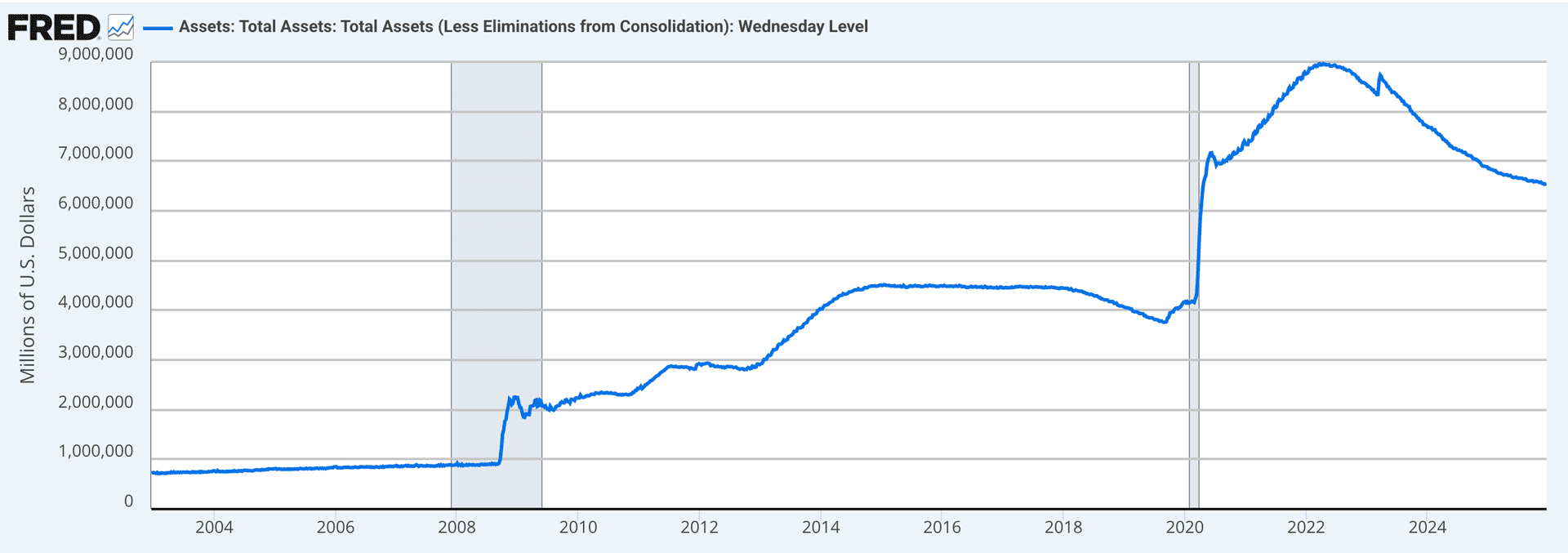
Fed Balance Sheet (WALCL)
- What it measures: Total assets held by the Federal Reserve. This is the cumulative amount of money the Fed has created through asset purchases.
- Why it matters: The ultimate indicator of QE (balance sheet expanding) or QT (balance sheet contracting). Every dollar on this balance sheet represents money injected into the financial system.
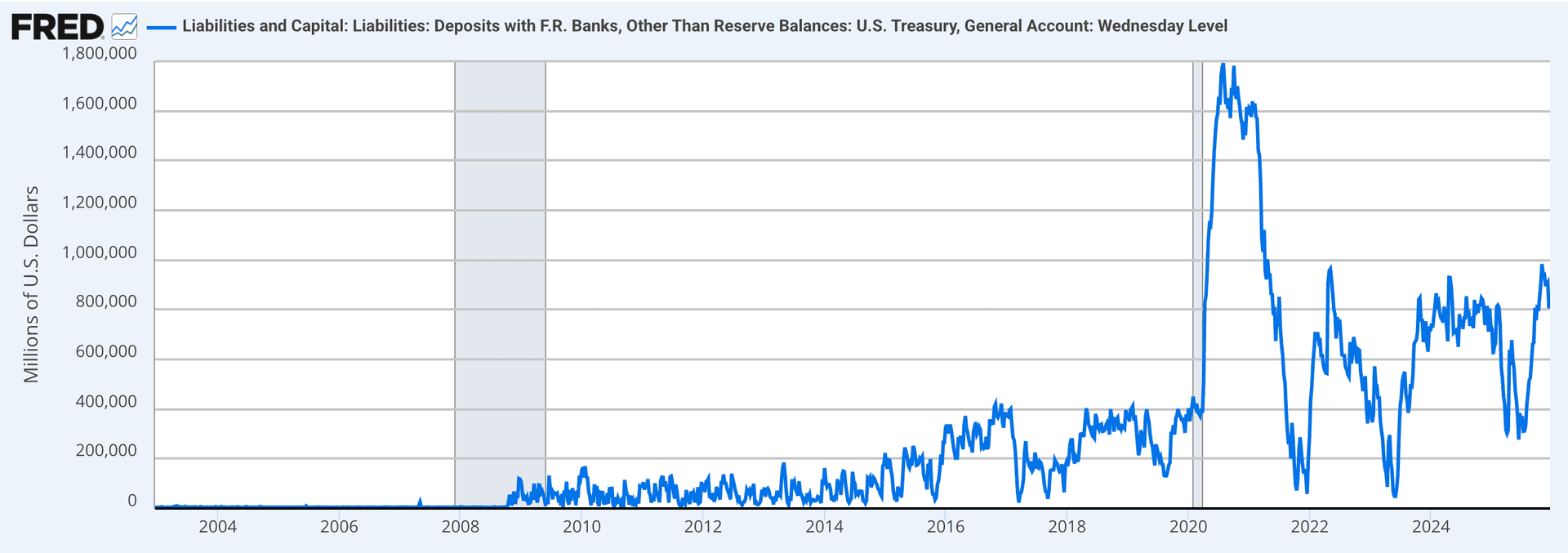
Treasury General Account (TGA)
- What it measures: The U.S. Treasury's checking account at the Fed. Where tax receipts get deposited and government spending gets paid from.
- Why it matters: When TGA rises, it drains liquidity from the financial system (money moves from banks to the Treasury's account). When it falls, it adds liquidity (Treasury spending puts money back into the system).
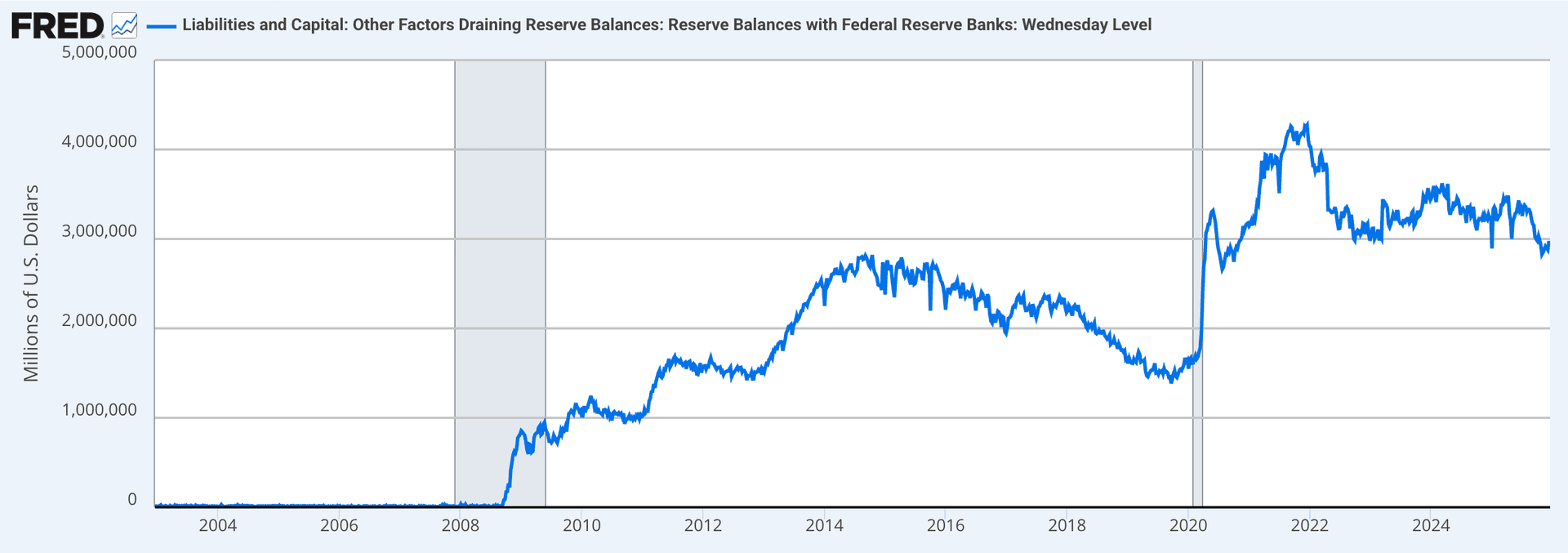
Reserve Balances (WRBWFRBL)
- What it measures: Total amount of reserves banks hold at the Federal Reserve. These are the deposits banks keep at the Fed beyond their required minimums.
- Why it matters: High reserves mean high liquidity - banks have plenty of capacity to make markets and extend credit. Low reserves mean low liquidity - banks become more cautious about deploying capital.
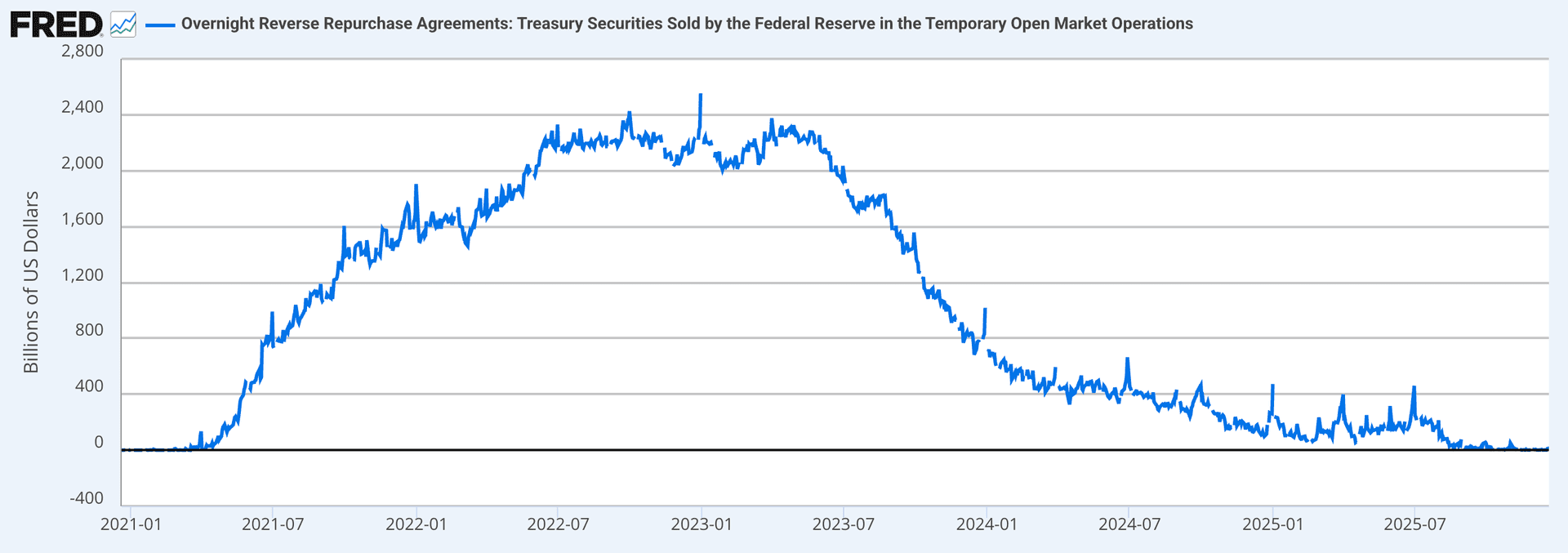
ON RRP Levels (RRPONTSYD)
- What it measures: The actual dollar amount parked at the Fed's Overnight Reverse Repo facility. This is where money market funds and other non-bank institutions can safely park cash overnight.
- Why it matters: High usage indicates excess liquidity looking for a safe home - there's more cash than attractive lending opportunities. Declining usage can signal liquidity getting absorbed elsewhere in the system or improved investment alternatives.
Standing Repo Facility (SRF)
- What it measures: A permanent Fed backstop that allows eligible institutions to borrow cash against Treasuries at a standing rate.
- Why it matters: Introduced after September 2019 as a safety valve to prevent another repo crisis. It's essentially insurance - available if needed but ideally unused.
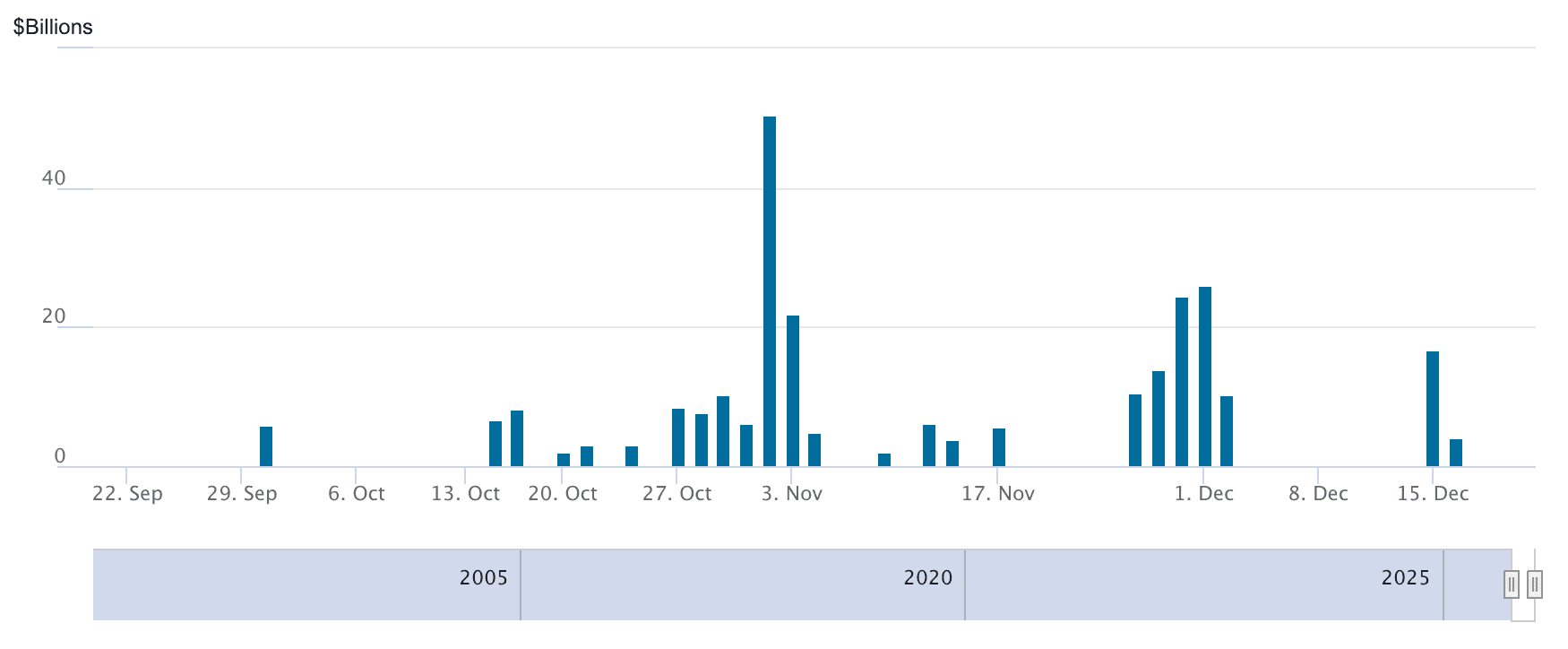
Putting It Together
SOFR is the most important real-time measure of repo market health. When SOFR is stable and trading near the Fed's target range, the plumbing is working. When SOFR spikes or shows unusual volatility, stress is building.
But SOFR alone doesn't tell you why. That's where the balance sheet metrics come in. Are reserves getting too low? Is TGA draining liquidity? Is ON RRP usage collapsing?
Problems with rates eventually force changes in the balance sheet - the Fed expanding reserves, adjusting facility usage, or ultimately restarting QE.
Watch SOFR. Watch reserve balances. Watch facility usage. These aren't distant policy indicators - they're early warnings of Fed intervention and the liquidity that follows.